
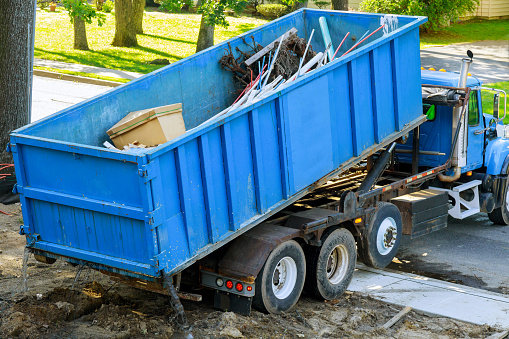
The smallest roll-off we keep on the truck is a 15 yard. It runs 16 feet long, 7.5 feet wide and 48 inches tall, and it is rated to one ton. For a garage cleanout, a bathroom remodel or a weekend of decluttering, that is the right box, and it is the one we can usually have on your driveway same day or next day. You will see 10 yard containers advertised around Springfield. We can get one, but it is a special order placed over the phone rather than something sitting on our lot. For almost every small job, the 15 yard is both easier to get and easier to load.
Here is the full lineup, straight off the spec plate, so you can size a job without guessing.
| Container | Dimensions | Weight allowance | Built for |
|---|---|---|---|
| 15 yard | 16 ft x 7.5 ft x 48 in | 1 ton | Small cleanouts, decluttering, small remodels, garage cleanouts |
| 20 yard | 16 ft x 7.5 ft x 6 ft | 2 tons | Whole-home cleanouts, small remodeling, downsizing |
| 30 yard | 20 ft x 7.5 ft x 6 ft | 3 tons | New construction, commercial build-outs, roof replacement, multi-unit cleanouts |
Notice that the 15 and the 20 are the same footprint. Both are 16 feet long and 7.5 feet wide. The only thing that changes is how tall the walls are, 48 inches against 6 feet. So if you are worried about whether a container will fit in your driveway, our 15 yard roll-off container and the next size up take exactly the same space on the ground.
A 10 yard sounds like the safe choice when a job feels small. In practice it is the size people regret most often, for one reason: a roll-off runs out of weight before it runs out of room.
Low walls are the giveaway. The 15 yard is 48 inches tall and carries a one ton allowance. You can fill it to the rail with household clutter, old furniture and cardboard and never trouble that figure, because none of it is heavy. Put half a bathroom in there, tile and mortar and a cast iron tub, and the weight is gone while the box still looks empty. A 10 yard shortens the box without changing that arithmetic. You pay for a smaller container and hit the same ceiling sooner.
The second reason is plainer. A short container has less rail length to pitch debris over, so loading takes longer and more of it ends up on the driveway. The 15 yard gives you 16 feet of side to work from.
Jobs we send a 15 yard out on most weeks:
The one thing to watch is dense material. Dirt, sod, concrete, roofing shingles and plaster are heavy enough that a 15 yard reaches its allowance well before the walls are full. If any of those are in the pile, say so when you call and we will put the right size on the truck instead of guessing from a photo.
Three signals, and any one of them means size up.
Forget cubic yards for a moment and answer two questions instead.
What is in the pile? If it came out of the ground or off a roof, it is heavy and the weight allowance decides your size. If it is furniture, boxes, brush or cardboard, it is light and the wall height decides it.
How many rooms? One room is a 15. A floor is a 20. A whole structure, or anything with a roof in it, is a 30.
That is the entire method, and it beats measuring. Tell us what you are clearing when you call and we will size it on the phone in under a minute.
From us, a 15 yard, on the truck and ready to go. A 10 yard is available as a special order by phone, but it is not a container we stock, and for nearly every small job the 15 yard is the better pick anyway.
It is a phone call rather than an online booking. Call and describe the job. Most of the time we will tell you the 15 yard costs you less trouble for the same work.
Yes, in most cases. It needs a clear run about 16 feet long and 7.5 feet wide, plus room for the truck to back in and tilt the box off. A standard two-car driveway handles it. Boards go under the rails to protect the surface.
Long enough to finish without rushing, and we can extend it if the project runs over. Tell us your window when you book and we will schedule the pickup around it.
Paint, solvents, fuel, lawn chemicals, tires, batteries and appliances holding refrigerant all have to stay out, along with anything chemically treated. Large volumes of concrete need their own container because of the weight. If you are unsure about something in the pile, call and describe it.
A small amount, yes, but it is the fastest way to use up a one ton allowance. For a real volume of soil, sod or rubble, ask about a heavier container when you call.
Call (417) 838-4398 and tell us what you are clearing. We will name the size, the day we can be there, and a flat rate with no weighing games at the end.